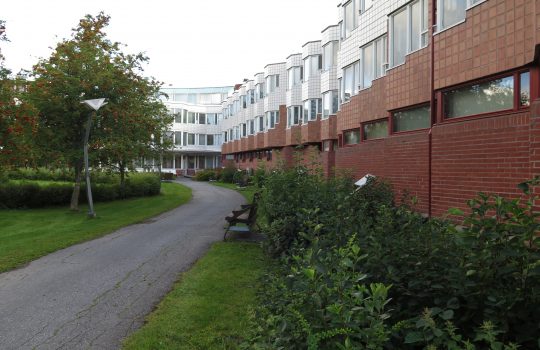
The intensive Masters Studies course is organised jointly between Landscape Studies and the Asema44 and Dodo associations and focuses on two main sustainability issues: firstly, placemaking as means of studying local meanings of a place, and secondly, protection and reuse of Modernist built heritage linking with welfare. The case the course is building on is the Himmeli elderly care home in Pori, built in 1986-1990 and designed by the architect couple Raili and Reima Pietilä. Himmeli witnesses a time when Pori entrusted nationally renowned architects with the design of its public buildings and is now one of the foremost examples of Modernist architecture in the city, protected by planning regulations. However, it has had no welfare use since 2021 and has been empty ever since. The group Asema44, currently running the activities at the former bus station of Pori, has plans for the future use of Himmeli, while Dodo has a long track record on activating and reuse of public spaces in different Finnish cities.
Welfare services in Finland are becoming increasingly concentrated, leading to a growing number of welfare buildings, such as hospitals, health centres, schools, libraries, kindergartens and elderly care homes, becoming disused. These are as a rule owned either by state of municipalities,struggling to find new uses to them. Many of the buildings date back to the intensive development period of welfare services from 1950s to 1980s and may no longer be technically fully top notch. Some have fallen into neglect and are easily labelled as worn out or even "risk structures". Recently discussion on lowering the demolition threshold for former welfare buildings has gained momentum. However, according to sustainable principles for using resources prolonging the life cycle of buildings by finding new uses should come before demolishing. Several old welfare buildings are also deemed architecturally valuable. Himmeli, together with the adjacent and still functioning Taikurinhattu kindergarten also by Pietiläs, is made more interesting as a case as it is located outside the centre in the middle of the Eastern Pori suburbs largely deriving from the 1970s, making it a landmark for the local communities.
The course starts with a preliminary assignment, shared with the students after the enrolment has closed on 2 September. The course week opens on Monday 21 September by introduction and discussion on the preliminary assignments. Lectures will go on for Tuesday 22, the topics covering placemaking and mapping, Dodo and Asema44 activities as well as the Modernist built heritage and its conservation challenges in Pori and Himmeli, the Pori cultural building plans and investment programme. On Wednesday 23 Himmeli will be studied at first hand and examples from reuses of urban spaces from elsewhere in Pori and in Finland will be presented. Thursday 24 will be fully reserved for the group assignment of organising thematic workshops on analysing the Himmeli space and doing community mapping and scenarios. Lastly, workshop outcomes will be presented on Friday 25, ended by a debriefing of the course. For passing the course, preliminary and group assignments and active participation are required.
- Opettaja
Maunu Häyrynen